


Among the Pecan Trees: Tami Cavitt of CLC Pecans
In celebration of the Year of the Woman Farmer, we’re highlighting women whose work sustains New Mexico’s agricultural landscape in powerful and often unexpected ways. New Mexico consistently ranks among the top two pecan-producing states in the country— a remarkable fact that many are surprised to learn. This interview features CLC Pecans’ Tami Cavitt, a retired college professor turned pecan farmer whose 35-acre orchard in southeastern New Mexico has become both her livelihood and her “happy place.” From classroom to orchard, her journey reflects the many pathways into agriculture — and the persistence, gratitude, physical labor, and deep connection to land that sustain it.
Below, she shares how she found her way into pecan farming, what it really takes to grow and sell nuts year-round, and why fresh, local pecans are unlike anything you’ll find at the grocery store.
SFFMI: New Mexico is one of the top pecan-producing states in the country. How did you decide to go into pecan farming?
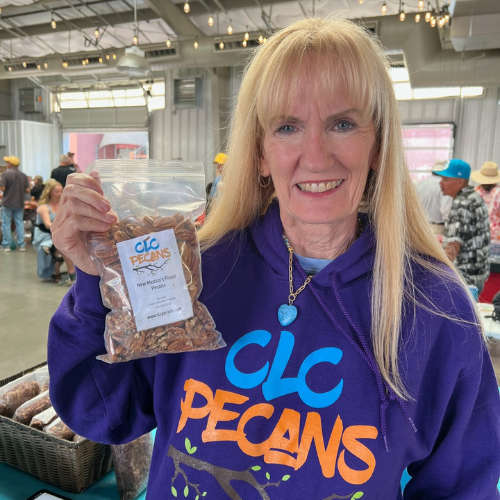
Tami: We’ve grown other things in the past, but the pecan orchard belonged to the superintendent of schools in Levington who hired me for my first job in 1980. When he passed away, his wife couldn’t take care of the orchard and his son asked me if I had any interest. I went over there and I said, “you know what? I am interested.” It’s beautiful there. It’s 35 acres of gorgeous pecan trees.
I am a retired college professor. I retired in 2017. I had 150 students every semester for 37 years and I just needed a change of trajectory for my life. And so I was really happy to find something where I could be outside.
SFFMI: What do you love most about being out on the orchard?
Tami: When I’m out there on the tractor and mow it. We don’t spray anything, so we monitor everything literally by hand. I mow everything to keep a cover crop on the orchard. But it’s just a great place to be out there with the trees. And being on that tractor and mowing and seeing the pecans growing and hearing the birds—it’s just a happy place for me.
Now don’t misunderstand, it is really hard work. I will candidly tell you, I underestimated the amount of work that it would be. Because there’s a lot to do on the orchard. We’re trimming trees, we’re mowing the weeds, we’re fixing sprinklers.
Especially after a hard winter like we’ve had—a lot of water lines bust and it’s not all tranquil. It’s hard work, but when I see the finished product, that makes it all worthwhile.
SFFMI: What does a typical season look like for you?
Tami: With 35 acres, it’s a bunch of rows, and I have to hit each row four times. It takes me four full days to mow. And after I finish a row and I’ve gone around all the trees, I can look back at it. It’s kind of like at the end of a semester [of teaching]. After you’ve graded that last test and you turn in your grades. You’re done. It’s that kind of euphoric feeling when you think, “Okay, done.”
And when the orchard is mowed, it’s beautiful. And just walking out there amongst the trees and having it be so beautiful after my effort. That’s a really good feeling for me.
I also like that feeling after harvest—when the last pecan is picked up and we’re finished, and I know that we’re ready to start again.
During harvest, we use micro sprinklers. We’ve got some big equipment going through [the orchard], so a lot of times we’ll knock over a sprinkler—not just one or two, but quite a few. So after harvest, we have to go put the sprinklers back in place and make sure that all the trees are getting watered.
Any agricultural endeavor requires effort. I have total respect for my fellow farmers, because I know how much work we all do.
SFFMI: Many people only see the finished product at the market. What do you wish they understood about the work behind it?
Tami: When you walk down the row at the farmer’s market, all you see are beautiful vegetables or nuts or flowers or wreaths or chile ristras and I don’t think most people have a true appreciation of the effort that it took to get to that place.
Once we’ve picked up [all of our pecans], that’s just the beginning. Because then we have to shell all of them and put the shelled pecans in the bag. Then we have to sell the bags. There’s a lot to it.
I usually harvest between 55,000 to 70,000 pounds of pecans. I sell part of them wholesale and shell the rest. And the first thing I do when I get the pecans is I put them straight in the freezer. Then I take them out to shell them, and put them right back in the freezer. So I keep them frozen all the time to keep that natural oil in the nut. You can keep them up to two years safely in the freezer.
A lot of people think, “well, just put the nuts in the pantry, because that’s what I buy at Costco.” [Store-bought nuts] are not frozen, but they’ve been processed. Whereas mine are just natural nuts. I don’t put anything on the nut—it comes straight from the tree, shelled, and put in the bag. That’s it. That’s why they always taste fresh.
SFFMI: What else makes local pecans different from what people buy at the grocery store?
Tami: When you see mine at the market, they’re a lighter golden color, and they’re moist. Because none of that natural oil has leached out. When you buy them at the grocery store, you have no idea how old they are. And they’re dry, and they don’t have a lot of flavor. They’re processed probably at some place that’s added a lot of chemicals to them to keep them in a dry bag.
Over the years, I’ve had hundreds of people tell me “I ran out of pecans and I had to go buy them at the grocery store—and I’ll never do that again.” Once you’ve tasted a fresh pecan and you see the natural flavor of it, you don’t want to go back to that. It just doesn’t taste good. You’ve also stripped the pecan of all the nutrients. Because the nutrients are in the natural oil in the nut, which is why I freeze them to keep all the nutrients inside.
SFFMI: What makes southern New Mexico such a great place to grow pecans?
Tami: Weather, low elevation, and water. For us, in southern New Mexico, we are extremely—and I cannot emphasize the word ‘extremely’ enough—blessed to have a good water source.
I have an underground well, and I pull off of the Ogallala Aquifer. Pecan trees require a lot of water. I turn on the water in May and I water through October. I’m very blessed to have plentiful water and I realize that.
The pecan trees I have are 47 years old, because I bought an existing orchard. And so, a lot of my water pipes are breaking. I’m having to replace water lines, which is labor intensive and expensive. But I’m still very grateful that I have plenty of water.
SFFMI: Have you faced any specific challenges as a woman farmer?
Tami: I would say minor, more physical challenges in terms of moving equipment around. I have to take the mower off and put the tiller on. We spray the trees with nutrients, so I also have to take the mower off and put on the sprayer. A lot of those are physically challenging jobs.
I can’t do it all by myself. My husband has to help me. But we don’t have a staff of people helping us. It’s my husband and me. So, mine is more of a physical limitation. And I’m sure there’s a lot of women in farming that are way stronger than me. But some of those big pieces of equipment, I just can’t do by myself. It’s a two person job a lot of times.
SFFMI: How did you begin selling in Santa Fe?
Tami: My daughter went to Baylor and took her first job in Dallas. One day she was getting her oil changed sitting next to a young man… he gave her his number and things progressed—he asked if he could marry her, and we agreed. He is from Athens, Greece and wanted to get married in a Greek Orthodox church. The Greek Orthodox church in El Dorado is the one they picked for the wedding.
When we were all in Santa Fe for the wedding, I told my husband, “wouldn’t it be nice if we had a place here that we could all gather?” And so we got a realtor, we started looking, and we bought a home. And so I had these pecans, and we went to the Farmers’ Market every Saturday. And I said, “I wonder if anybody would buy pecans at the Farmers’ Market?”
They let me in as an invited vendor for five years. And then after five years, I became a full member of the Farmers’ Market. We go to Santa Fe every two weeks because I sell to a lot of restaurants there and they depend on my pecans. And people call me to ask, “when are you going to be here?” So I’ve turned my hobby and my fun time into a business.