
Farm, Family & Stewardship: A Conversation with Val Wilson of
Lotus Farms
In celebration of the International Year of the Woman Farmer, we’re highlighting women who are shaping our local food system with integrity, resilience, and heart. Today we’re featuring farmer, mother, and SFFMI board member Val Wilson, whose journey into agriculture began not with a farming background — but with a commitment to health, humane animal treatment, and family.
Below, she shares in her own words what it means to raise animals with intention, balance multiple careers, and build a future for local food.
SFFMI: Can you tell us a little bit about your farm and how you got started?
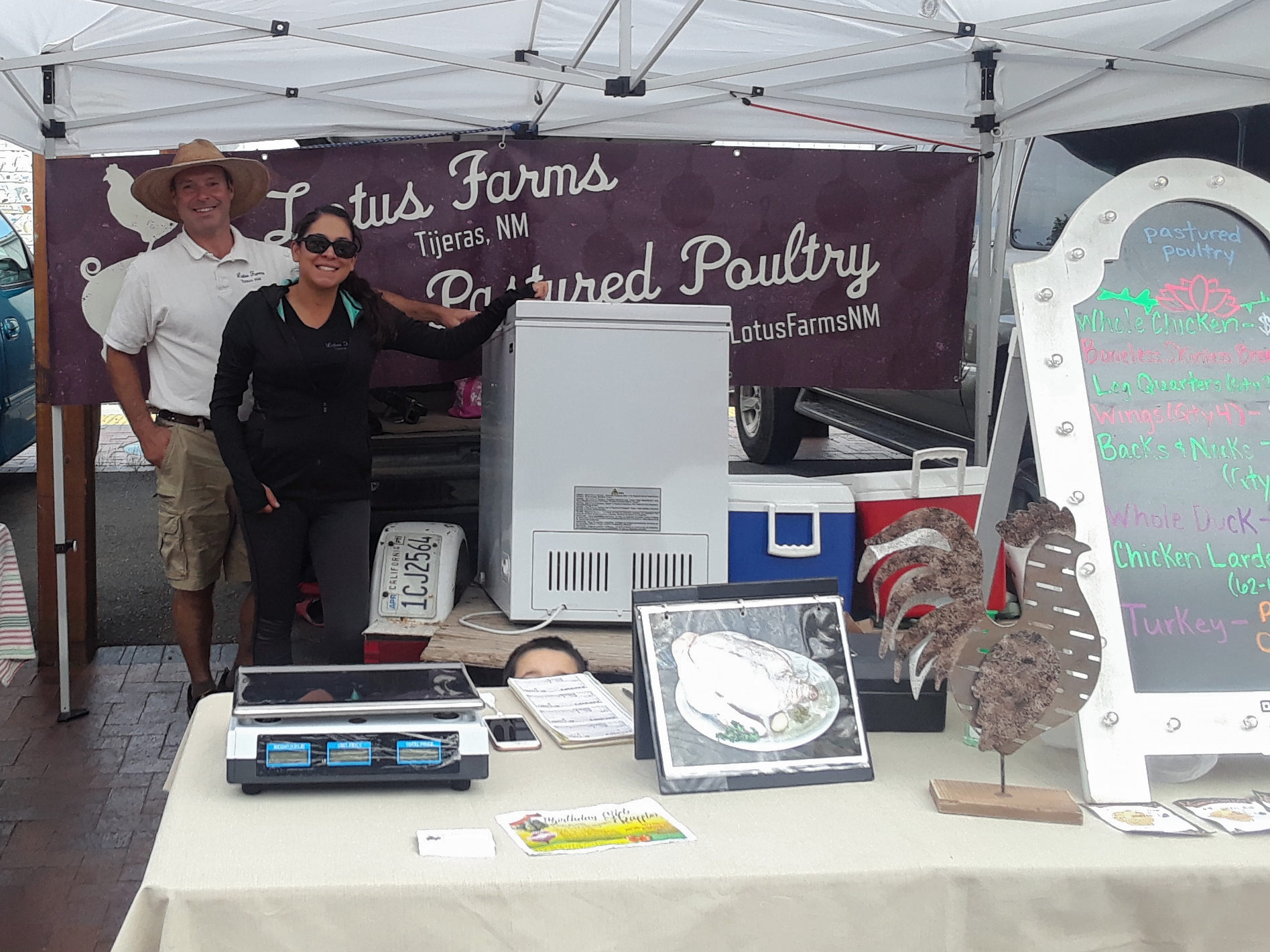
Val: This is our eighth year of farming. The farm has primarily been my husband’s full-time job. I started part-time helping with chores and helping with the harvesting of the birds. We raise pastured poultry, so ‘meat birds’ that are organically fed.
The pastured poultry model is one of the most humane ways to raise meat birds, especially when you compare it to factory farms. Coming from [being Executive Director of] Animal Humane New Mexico, obviously the humane treatment of all animals is really dear to my heart. So, a big part of our operation is making sure that our employees are handling the animals humanely and safely.
When we started the farm, I had previously had thyroid cancer, and so we started really looking at what we were putting into our bodies and putting into our kids’ bodies. And my husband, Grant, really wanted to do something—a new career, essentially. And so, he’s the one that found the pastured poultry model. We also found the forested pork model, where the pigs are raised in the forest.
With large animals, obviously, it was going to take a lot of infrastructure. So, we felt from a business perspective that starting with the meat birds would be easier and less investment as we were just starting the operation.
Then, during COVID, we added the forested pork model to the operation. The pigs start in a little nursery, learn and get trained to the hot wire, and then they move up into the forest and are rotated throughout the forest in hot wire areas. They are organically fed as well. But they eat the oak thickets, the pinon canopy. They make their own natural wallows. They love living in the forest.
SFFMI: What does your farming model look like day to day?
Val: My husband and I, neither of us come from farming backgrounds. So, the first couple of years was a big learning curve, understanding the amount of time that goes into farming. These are living animals. So, they need care two, three, four times a day. In the summertime when it’s really hot, their waters have to be filled multiple times a day.
Predators can be an issue as well. We have a lot of livestock guardian dogs that we didn’t bring onto the farm until about 2020. They’ve really helped with any losses that we have to predators. We do have coyotes. We have foxes, raccoons, mountain lion. We have had a bear up on the pasture before. The bear was interesting. They don’t want to eat the birds. They just want the feed. So, they go in and rip up the tractor that the birds are in and then all the birds get out and other predators come.
I feel like my husband and our farm team really have it down now and know the process and the routine. So, I would say it’s easier now, but still a lot of work. It’s very different than raising beef cattle where you kind of let them go and check on them every couple of days. This is a lot more labor intensive type of farming.
SFFMI: You work in animal welfare professionally. Have you ever felt tension between that work and raising animals for meat?
Val: When I was in college, I was a vegetarian because I went to an agriculture school and I learned all the different ways that you could process birds with most of them not being humane at all. And that really did affect me in terms of how the animals were being treated.
When I was vegetarian, I had a lot of medical issues and didn’t feel like I was my healthiest at that time. I’ve always had a lot of medical issues and protein and meat proteins have been a vital and very essential part of my diet to maintain my health and well-being.
We spent a lot of time talking to our kids about the fact that these animals are coming to live with us. We are their caretakers. We want to give them the best life possible. It is a short life that they are sacrificing for us to have a good well-being and a good quality of life ourselves. So, we want to make sure that these animals are getting that in return.
I’ve never felt like it is a conflict. The mission [at Animal Humane] is about cats and dogs. So, obviously different. But knowing that these animals are living the best life that they could possibly get [is important to us]. We look at these 4,000 birds and think, “We’re so lucky. They made their way to our farm. And we’re going to continue to be grateful for the sacrifice that they made so that we can continue living.”
Our children now are teenagers. They work at the market most Saturdays with us. They know the whole process. They’ve processed birds. They’ve harvested birds. They’ve gone to the butcher. So, they’ve seen from start to finish. So, to me, it’s a beautiful story because they’ve learned from when they were children what is good stewardship of the animals versus factory farms where they are not living in the best conditions.
SFFMI: As a woman farmer and a mother, what challenges have you faced?
Val: I think the biggest challenge is that I do have a separate career. And in the beginning, the first six months were pretty rough because I was working 40 to 50 hours in my actual career. Then Fridays, my husband and I would butcher and process the birds all day long, which would be a 16-hour day. We would go to market on Saturday and then, of course, come home and take care of the birds at night and on Sunday.
I feel like as a mother and as a woman, sometimes we wear so many hats. And to find the time to devote to all of the different hats that we wear, I think, is the hardest part for women in farming, in agriculture—in any business really. Because we are getting pulled in so many directions.
As the farm has evolved, I have stepped away a lot. I became the Executive Director of Animal Human New Mexico in 2022. Now, a couple times a month, I’ll go out and do chores with Grant. I do attend market most Saturdays, especially during our peak season. That’s our family time together. We enjoy that aspect of it.
I’m also the bookkeeper and the social media person when I have time. And the marketing person when I have time.
Would you recommend farming to other women or mothers?
Val: I’ve always called our farm our oasis. It’s away from the busy part of Albuquerque. We’re 30 minutes out. We really don’t have a lot of neighbors. And we have all of our dogs and our family.
I think as a working mother, it does give you flexibility to be a part of your children’s life in a different way where you can work around the schedule to do pick up, to do drop off, to attend the school activities. So, for someone who wants to have a family, I think it’s a beautiful opportunity.
With protein farming, you build a lot of different skills because you are harvesting, you’re processing the birds and cutting down into different pieces and parts. But you’re also growing a business.
Yes, the farm work is there. But outside of the farm, we’re developing relationships and partnerships and that’s something I don’t think is talked about enough as women in farming. Women are very good at building relationships. And I think that is almost a unique factor that women have over men, in my opinion—because we can build those relationships and grow the business in a way that we want it to evolve.
SFFMI: Why is it important for people to support local, humanely raised meat?
Val: I think, obviously, we are looking at feeding our local community. And I think it extends beyond the farmers’ market. But how do we educate people more about the different practices and models in factory farming, especially when it comes to the larger animals and the birds?
The more we can educate in schools — get at the younger generation — then they come home and tell mom and dad, “oh, I don’t want to eat that chicken, we should eat this chicken.”
But, also, it has to be sustainable for people to be able to purchase it. That is what I fear with inflation and the different things going on in the country right now: Where does that leave the average community member to be able to purchase [humanely grown meat] and have that be sustainable? That’s probably what I fear the most for the future of all farms.
Also, a lot of our farmers at the Santa Fe Farmer’s Market are aging out and retiring. But how are we pulling in the younger generations for future farming so that we continue to have local food access? That’s a topic we talk about at the Institute board level all the time: what does that impact look like and how do we continue to bring in the future farmers?