


Leading the Institute’s Next Chapter: A Conversation with Executive Director Syri Mongiello
For more than ten years, Syri Mongiello has helped guide the work of the Santa Fe Farmers’ Market Institute behind the scenes as its Operations Director. Now, as the Institute’s new Executive Director, she is bringing that experience, institutional knowledge, and deep connection to Northern New Mexico into a new leadership role.
In this interview, Mongiello reflects on what first drew her to the Institute, the values she carried from growing up in Taos, and why expanding access to local food is such a central part of the organization’s mission. She also shares her hopes for the future of the Institute, the importance of supporting local farmers, and how strong local food systems help create healthier, more resilient communities.

SFFMI: What first drew you to the Institute, and how has your perspective on its work evolved since you first joined the staff?
Syri Mongiello: I was first drawn to the Institute because working for an organization affiliated with the Farmers’ Market seemed like a good idea when I was new to Santa Fe. I thought, “This is a central organization in the community and an opportunity to meet people.”
Over time, deepening my understanding of our work and seeing our programs grow has been really inspiring.
What has inspired me most recently is the expansion of our Local Food for All programming and the mobile market, and feeling like we’re expanding the reach of the Farmers’ Market by bringing food out into the community where it is needed.
What does becoming Executive Director mean to you?
I’ve been here for 10 years, and there were opportunities in the past when we had turnover in the executive role, but I wasn’t ready to take it on then. This time around, though, I felt like I had so much organizational memory and knowledge about what we do, our relationship with the Farmers’ Market, and our role in the community. I felt more prepared professionally to step into the position.
I’ve been in a leadership role within the organization for a long time, and over the years I became relied upon for institutional knowledge. That allowed me to build trust with both the staff and the Farmers’ Market. I have a strong working relationship with the Farmers’ Market staff and board.
As someone who grew up in Northern New Mexico, how has that experience influenced the way you think about local agriculture, food access, and community?
I like contributing to the health of the place where I live, and I think that value stems from growing up in a small town. Taos is small and people felt connected to one another. Working for an organization that has an impact where I live is meaningful to me because I always felt connected to the people around me, whether I knew them personally or not. They’re still your neighbors, even if they don’t live next door, and that’s a value I try to instill in my son—having respect for everyone around you.
As far as supporting local agriculture, I think food is at the heart of a healthy community, and we’re facing so many challenges around food access these days, from high prices and food deserts to barriers like transportation and work schedules that make it difficult for people to access fresh, healthy food.
We’re much more resilient if we support our local producers, because it brings the food system closer to us and reduces our reliance on larger systems that are impacted by everything that’s going on in the world. It’s a much smaller system, and if we can focus on supporting that, then we can be more resilient as a community.
Looking back on your years with the Institute, what moments stand out as especially meaningful?
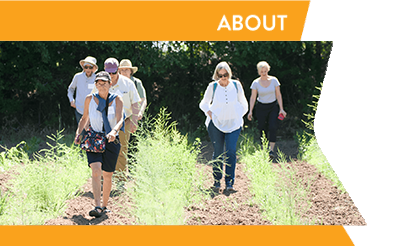
I think there’s two things. One was the first time I got to visit a farm. I’d been to farms before when I was a kid, but visiting the farm of someone I’d come to know from the Farmers’ Market and seeing where the food they bring to market is grown was deeply meaningful for me. It made a connection that somehow hadn’t been made before, even though I grew up in a ranching and farming community and my neighbors were ranchers. There was something about being on the farm with people I knew personally and seeing where the food I bought from them was harvested that stayed with me.
Another memorable experience came through a major Pavilion improvement project I led that involved an electrical upgrade. We brought more power to the building, and we put the floor outlets into the market hall that enabled more farmer vendors to have power at their booths. We do what we can to help enable the farmers to have a more successful business experience at the Farmers’ Market. That was the first time I realized that’s what this building is doing. We’re enabling the market to be more successful by keeping this infrastructure going. We get to have a year-round farmers’ market because of this building.
What excites you most about leading the Institute into its next chapter?
I’m really excited about the Local Food for All initiative. There are still many people in our community who can’t come to the Farmers’ Market for one reason or another and I like that we are helping to expand access to local food beyond the borders of this building.
Our ability to bring local food to different communities through the mobile market and our Bulk Food partnerships is really exciting to me because it feels like we’re expanding our impact. We source food from local farmers and work with partners to get it out to rural communities across Northern New Mexico.
What do you wish more people understood about the Institute and its impact on the community?
I wish that the Institute had more of a visible identity in the community. We are frequently confused with the Farmers’ Market, and while our connection is important, we’re two separate organizations. I wish people had a better understanding that the Institute is a 501(c)(3) nonprofit and a potential recipient of charitable giving. We do work that impacts the community and is worthy of support.
Having better visibility in the community is what I would like to work toward.